Saturday, November 26, 2016

Family Sabbatical (1956)


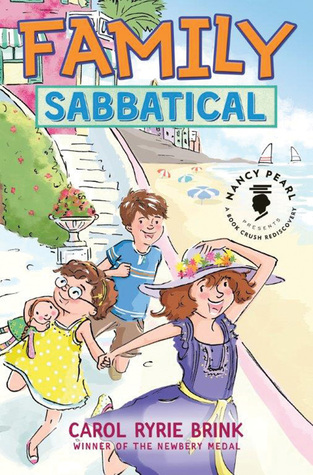
Family Sabbatical
Carol Ryrie Brink, il. Susan Foster
1956, Viking
2015, Two Lions/Amazon as A Book Crush Rediscovery (cover Joanne Lew Vriethoff)


So then they had gone in, through the vast lobby with the torn carpet and the potted palms and the cherubs painted on the ceiling. They had gone through the small hall with the two great mirrors opposite each other, arranged so that if you stood between them you could see yourself reflected back and forth hundreds of times until you receded away into the distance on either side and vanished into two points. Then they had gone on through the writing room, which would be just the place for Mother's and Father's work. And then they had come to the  garden! It was very large and old and overgrown. 


The Ridgeway family of Midwest City have come to France for their professor father's sabbatical. For six months, he will work on a history book while their mother works on a sequel to her recently published mystery. Their first stop is Canne, where they stay at The Grand Hotel Majestic et de l'Univers, where the elevator is frequently not 'walking.' There, the children acquire a governess and befriend a mysterious old woman who is key to meeting a real princess.

Susan (13), George (10) and Dumping (7) were first featured in Brink's Family Grandstand.  In that book, the professor's children were cozily established in their Minnesota hometown.  Here, they explore another country and culture. The two older children frequently ask Dumpling, the sturdy youngest, to ask her if this experience or that place is nice.  Yes, she always responds, but home is better.  At times, the others agree.  They get homesick for American food, staring longingly into a store which sells expensive imported Campbell's Soup, and hate their school in Paris, where all three end up in the same class for much younger children because none of them speaks a word of French.

As a child, I found this book memorable for the brief glimpses of an unknown world. The Marseille market selling Christmas Nativity scenes, the cats of Paris,  the oubliette where Irene is lost, the Chateau d'If, the rock garden in their Cannes hotel garden.  I loved it for the family scenes, like the improvised Halloween the children stage, complete with haunted house, and the Christmas decorations they make on a cold, rainy day in Paris.

I am clearly not the only one who recalled this book.  It was republished in 2015, as part of Nancy Pearl's Book Crush Rediscoveries. The first book, Family Grandstand, was also included in this series by Two Lions.  I'd suggest adding The Pink Motel to round out the list.


Links
Review


Monday, September 7, 2015

Return To Hackberry Street (1967)


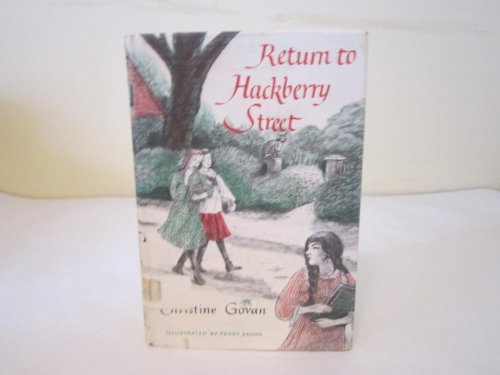
Return To Hackberry Street
Christine Govan, il. Peggy Bacon
1967, The World Publishing Company

The last week of August was hot and dry. The leaves fell from the trees and lay in brittle, dull-green drifts along the sidewalks and the roads…. “What a time to start school!” cried Jessie, crossing the room and pulling up the shade. She threw herself down on the bed and Katie lay back in the big split-bottomed rocker near the window. It was too hot to move, so they just talked again about the new girl.

Jessie Bolton and Katie Warren are grousing about startin  Across town, Laura Hewitt is miserably protesting her family’s move from cosmopolitan Nashville to small town Madison for the umpteenth time. Her mother suggests she invite her city friend to visit, and Laura isn’t comforted.
g school the next day, about the new bank manager’s daughter, and how they just know she’s going to be a snob like the last, their old enemy Gladys Joyce.

“What would they do in this dead, ugly, dried-up little one-horse town? Oh, Mamma!”

The girls inevitably clash.  Since there are only 5 girls in the entire class, Laura quickly becomes a recluse.  Jessie’s little brother Frank, meanwhile, loses his happy if mostly useless hound mix Spot after unwisely (and untruthfully) bragging to some shifty locals about the dog’s hunting prowess.  Laura’s role in bringing Spot home helps reconcile the girls, and brings about a happy resolution.

Atmospheric and nicely interested in minor action, like Jessie’s little sister playing paper dolls in the bathtub.

On the other hand
Kirkus, the long-lived book review, has a tendency to go for the throat. Their brief review of this book is brutal: 

Return is also to some once upon a time, maybe the turn of the century, but it's an indigent little story with old fashioned fixin's (paper dolls, the Sears Roebuck catalog, sprigged muslin). Laura Hewitt moves from Nashville to a small town and faces the coalition of Jessie Bolton and Katie Warren. This deals then with the resolution of city girl-country girl, old girl-new girl resentments, with a little action in the disappearance of a favorite coon dog, Spot....""Lawzee""--lethargy on the back porch.


Tuesday, September 24, 2013

Autumn poetry


They’s something kindo’ harty-like about the atmusfere
When the heat of summer’s over and the coolin’ fall is here—
Of course we miss the flowers, and the blossums on the trees,
And the mumble of the hummin’-birds and buzzin’ of the bees;
But the air’s so appetizin’; and the landscape through the haze
Of a crisp and sunny morning of the airly autumn days
Is a pictur’ that no painter has the colorin’ to mock—
When the frost is on the punkin and the fodder’s in the shock. 

When the Frost is on the Pumpkin
James Whitcomb Riley was never married and never had children, was an indifferent student who would never have a good word for a teacher, a drunk, and a wildly successful writer of sentimental poetry for children.     


My mother read me his poems when I was a child; I remember the spooky ones best:

Little Orphant Annie's come to our house to stay,
An' wash the cups an' saucers up, an' brush the crumbs away,
An' shoo the chickens off the porch, an' dust the hearth, an' sweep,
An' make the fire, an' bake the bread, an' earn her board-an'-keep;
An' all us other children, when the supper-things is done,
We set around the kitchen fire an' has the mostest fun
A-list'nin' to the witch-tales 'at Annie tells about,
An' the Gobble-uns 'at gits you
Ef you
Don't
Watch
Out!

His poems lent themselves to impassioned readings, and that was how Riley lived for years; he made a fortune off travelling around reading his poetry.  Hugely popular in his time, he’s now regarded as a minor poet, more noted for his effect on American culture and reflection of American history than for his work itself.


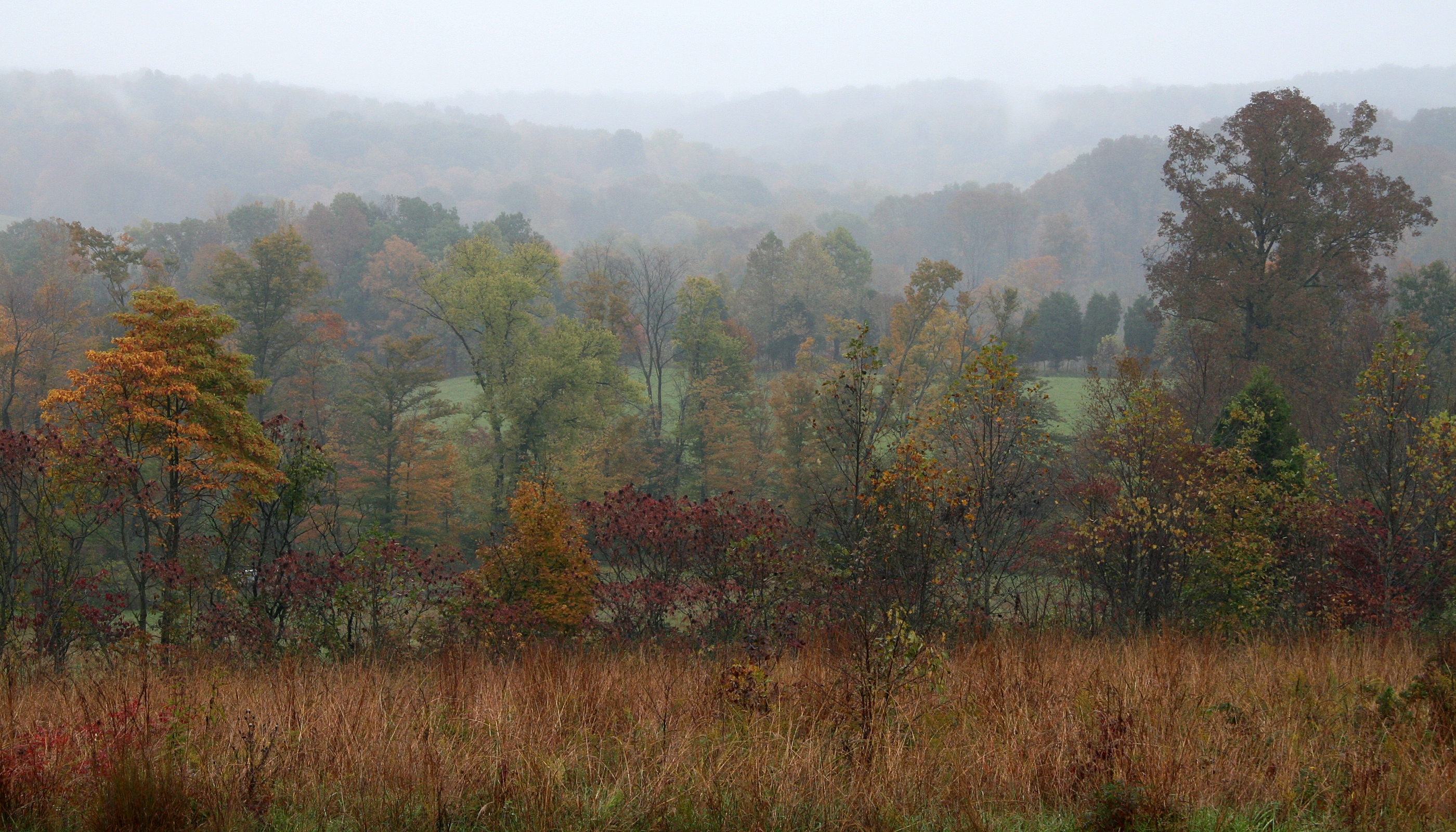
*landscape photo by Huw Williams (Huwmanbeing) (Own work) [Public domain], via Wikimedia Commons, of The Hoosier National Forest near Patoka Lake in southwestern Orange County, Indiana.
*haunted house image from the Children's Museum of Indianapolis
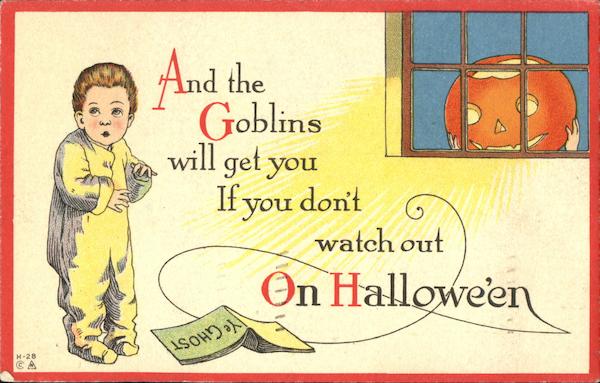
*postcard image from CardCow.com


Tuesday, April 20, 2010

Emily (1959)

I've run into technical difficulties, so am resorting to posting sans images. Which is a pity, as this book has very lovely paintings. The cover can be seen here.


Emily (aka Emily, The Traveling Guinea Pig)

Emma Smith, il. Katherine Wigglesworth

1959, an Astor book published by McDowell, Obolensky


Emily was a guinea pig who loved to travel.


When Emily decides to take an excursion to the sea, she worries that her brother Arthur, a gardener who tends to be somewhat hapless, will be lost without her. No worries, assures her brother. He'll be fine. So Emily sets out.


She carried an umbrella and a capacious canvas bag. They hampered her walking, but she did not know how she could go on a journey with less. She had to have an umbrella as shelter against the sun or the wind or the rain. And as for the bag, it was full to the brim of neccessary things. Her painting equipment and her diary ; food and a change of clothes ; kerosene lamp and tea kettle, a rug, hammock, a ball of string, a pair of scissors ; adhesive tape and iodine in case of an accident, and needs and thread in case she tore her dress ; also a box of matches. Emily liked to be ready for anything.


She meets various creatures, but her most important encounter is with the rather silent weasel, who helps her carry her useful but heavy bag, shares a meal, and is a rather sinister presence.


Meanwhile, back at the house, Arthur and his bachelor buddies are having a wonderfully lazy time eating and sleeping and not lifting a paw to do chores.


Will Emily reach the sea? Will the weasel prove predatory? Will Arthur clean the kitchen before Emily returns home? It's all very sweet, and accompanied by beautiful Kate Wigglesworth paintings.


About the Author

1923-

aka Elspeth Hallsmith

The online verdict seems to be that she had a brief, early flash of high respectability with her first two novels, then vanished off the face of the earth after starting a family. She re-emerged recently under the support of novelist Susan Hill.


About the Illustrator

____ - 1986

Katherine Semple married biologist Vincent Wigglesworth in 1928, and they had four children. She lived in Lavenham, a village in Suffolk, England. The village made the news this year after scenes from the upcoming Harry Potter And The Deathly Hallows film were shot there. Lavenham's scenes will be used to bring to life Godric's Hollow, the place where Harry lost his parents and acquired his scar.


Other books - children's

Emily's Voyage (1966) il. Irene Haas (sequel)

Out Of Hand

No Way Of Telling


Other books - adult

Maidens' Trip

The Far Cry

The Opportunity Of A Lifetime

The Great Western Beach (memoir)


Links

A list of guinea pigs in fiction

The original publisher, Astor Honor

Lavenham website

Sir Vincent Wigglesworth obituary

Suffolk Free Press story on Harry Potter filming

Thursday, March 11, 2010

Updates

A post from March, a review of The Witch's Bridge, has been updated with a photo of the paperback cover.

Saturday, February 6, 2010

The Big Snow (1949)


The Big Snow
Berta and Elmer Hader
1948, Macmillan Publishers

The winner of the Caldecott Medal for 1949, this picture book follows the world of a forest after a blizzard.


About the authors
Berta Hoerner (1891–1976)
Elmer Stanley Hader (1889-1973)

They were friends with Rose Wilder Lane, dating from Berta's days as Rose's roommate

Links
The Hader Connection
Beyond Little House

Saturday, January 30, 2010

Picture Book awards 2010

Picture-Books in Winter

Summer fading, winter comes--
Frosty mornings, tingling thumbs,
Window robins, winter rooks,
And the picture story-books.

Water now is turned to stone
Nurse and I can walk upon;
Still we find the flowing brooks
In the picture story-books.

All the pretty things put by,
Wait upon the children's eye,
Sheep and shepherds, trees and crooks,
In the picture story-books.

We may see how all things are
Seas and cities, near and far,
And the flying fairies' looks,
In the picture story-books.

How am I to sing your praise,
Happy chimney-corner days,
Sitting safe in nursery nooks,
Reading picture story-books?

Robert Louis Stevenson


AWARD SEASON FOR CHILDREN'S BOOKS


from Chester, The Worldly Pig, written and illustrated by Bill Peet, 1990 Caldecott Award Honor winner for Bill Peet: An Autobiography.


It's awards season for the entertainment world, books no less than movies, and a slew of kid book awards got announced this month. There is one large difference between awards given to material intended for adults, and awards given to children's entertainment - the judges in the latter case are very free to indulge their own biases, preferences and fantasies without regard to the intended audience, as that audience is completely absent from the judging. I'm not sure that's a reality that can be or should be changed, but it does make judging children's literature a different kettle of fish. The situation is intensified in the case of picture books, where the audience is too young to acquire or consume the books and completely at the mercy of adults to provide both the book and the reading.


The Caldecott Medal winners for 2010 were announced this month. This award goes to "the artist of the most distinguished American picture book for children."The 2010 winner is The Lion & the Mouse by Jerry Pinkney. 2010 Honor winners were All The World, illustrated by Marla Frazee and written by Liz Garton Scanlon, and Red Sings From Treetops: A Year in Colors illustrated by Pamela Zagarenski and written by Joyce Sidman. Pinkney is the first individual African-American to win the Caldecott Medal, which has been won twice by an interracial couple.


The Theodor Seuss Geisel Award goes to the author and illustrator of the year's "most distinguished contribution to the body of American children’s literature known as beginning reader books published in the United States". This year, the winner is Benny and Penny in the Big No-No! written and illustrated by Geoffrey Hayes. 2010 Honors winners include I Spy Fly Guy! written and illustrated by Tedd Arnold, Little Mouse Gets Ready written and illustrated by Jeff Smith, Mouse and Mole: Fine Feathered Friends written and illustrated by Wong Herbert Yee, and Pearl and Wagner: One Funny Day written by Kate McMullan, illustrated by R.W. Alley.


The Coretta Scott King Book Awards were also announced this month. The 2010 illustrator winner is Charles R. Smith Jr. for My People. The 2010 Honor for illustrators was The Negro Speaks of Rivers, illustrated by E. B. Lewis. Both were written by Langston Hughes.

And the Schenider Family Book Awards "honor an author or illustrator for a book that embodies an artistic expression of the disability experience for child and adolescent audiences." Their 2010 pick for Young Children's Book was Django, written and illustrated by Bonnie Christensen.


Links

The Caldecott Medals Home Page at the American Library Association

Coretta Scott King Awards at the ALA

The Schneider Family Book Awards at the ALA

The Theodor Seuss Geisel Award page at ALA


Seattle Times interview with Jerry Pinkney


Little, Brown and Company Books for Young Readers (The Lion & the Mouse)

Beach Lane Books (All The World) - a Simon & Schuster imprint

Houghton Mifflin Books for Children (Red Sings From Treetops, Mouse & Mole)

Toon Books (Benny and Penny in the Big No-No! and I Spy Fly Guy!)

Dial Books for Young Readers (Pearl and Wagner: One Funny Day) - Penguin Putnam

ginee seo books (My People) - an Atheneum Books for Young Readers imprint

Jump At The Sun Books (The Negro Speaks Of Rivers) - an imprint of of Disney Book Group

Roaring Brook Press (Django)


The New York Times bestseller list for Children's Books (Jan 29, 2010)


Wednesday, January 13, 2010

Odds and Ends

First, a picture to evoke summer in the dead of winter.

Stars For Christy (1958, author Mabel Leigh Hunt, illustrator Velma Ilsley)

Now, new books and newish movies.

Frances Hodgson Burnett's 1904 novel A Little Princess has gotten a not-particularly-necessary sequel from Hilary McKay. Wishing For Tomorrow has just been released in the U.S. While I've been a fan of McKay's Exiles and Casson series, I was underwhelmed by this one. There's nothing really wrong with the book, it's just that there's a sameness to it. An uncontrollable little girl who's a force of nature, a grinning boy who acts as an amused spectator to a group of mad girls, a book-obsessed girl, a clutzy heroine, jealousy, girlish intrigue - there were times when it simply all felt too similar to the Exiles and Casson family books. And I've never been a fan of an author hitching a ride on someone else's work, no matter how creative or well done their own effort may be.

Elizabeth Goudge's 1946 novel The Little White Horse is also a 2008 film called The Secret Of Moonacre. I've never truly recovered from the scene where Maria discovers a cunningly placed box of biscuits on the mantel in her dreamy new bedroom. Biscuits. Mantels. Villains named, literally, Blackheart. Lions. Unicorns. Midnight forest rambles. There's no way a nice, rousing film version won't ruin it.

I've always found the 1001 series by Universe - you know, those enormously fat books claiming to contain the films you absolutely MUST see, places you absolutely MUST visit, etc., etc. before you die - to be irritating. I read for many reasons, but not to be goosed into action by the idea that if I don't act now, I'll die uncultured and parochial. But everyone I know loves these books and scans them eagerly to see how they match up against the compilers, so it you like that sort of thing, Universe has produced a kid book version. 1001 Children's Books You Must Read Before You Grow Up by Julia Eccleshare, the children's book editor at The Guardian Review.

Tuesday, January 5, 2010

Beezus And Ramona movie

Beezus And Ramona is a movie! It's due out on August 13, 2010. How they will update the simple 1955 book - in which 10-year-old Beatrice 'Beezus' Quimby deals with her exasperating little sister Ramona - is anyone's guess. The obvious change is changing an average 10-year-old kid into a beautiful 18-year-old woman. The little actress playing Ramona is 11 - a year older than the Beezus character in the book.

Even granted that a) it's easier to have older girls play the roles than very young children, and b) the movie is likely based on the series as a whole, it's a bit sad. Every once in a blue moon, there's a Precious and everyone gets all KUDOS! about how they cast someone who remotely resembles the actual character. Then it's right back to casting stars who fall so far out of the original material's vision that you begin to wonder at the point of even using the original material. Oh, right - built-in audience.

Links
IMDB listing here
Beverly Cleary website
Harper Collins website

Saturday, January 2, 2010

The Story Of Little Babaji (originally Little Black Sambo)


The Story Of Little Babaji (originally Little Black Sambo)

Helen Bannerman, il. Fred Marcellino

1996, Harper & Row; (1899, original edition)


The background: the original title and illustrations of Helen Bannerman's late 19th century tale of a little boy's encounter with tigers was, due to circumstances beyond the control of the author or the children who enjoyed the book, impossible to maintain. 'Sambo' had become a racial slur, and the illustrations made many people uneasy.


In this updating, the story remains, but the characters are given more authentic Indian names, and the illustrations have changed from that slightly scary coarseness of turn-of-the-century cartoons to the soft warmth of Marcellino's watercolors.


About the Author

1862-1946

Bannerman was a Scottish woman who lived for many years in India, where all of her books are clearly set. The offense that surrounds them is due partly to undeniably alarming illustrations in early editions, but part of the problem must be laid at the feet of English writers born prior to 1980 and their habit of calling anyone with more pigmentation than a snowflake 'black,' and the confusion this creates when translated into American.

Tuesday, December 29, 2009

A New Year's fairy tale - The Little Match Girl

Fairy tales are, despite their sometimes grim content and often alarming messages, always for children. They're distinctly unsatisfying for adults. Their brevity makes them unsettling. Their action makes them downright scary. They are written as if by children, with that brutal, direct and virtually amoral style that sends a sensible grown-up running away to the relative comforts of Stephen King and Margaret Atwood.

First, a comparison. Charles Dickens' 1843 novella A Christmas Carol is a seasonal staple at this time of year. The tale of an embittered miser who becomes the most generous of men through having his eyes opened to the need and potential of others, particularly the poor, is eternally popular in a world which likes to focus on redemption and positive change. The mid-19th century produced many stories of wealth and poverty, love and indifference, as it was a time when the ruthless attitude that poverty was a) inevitable and b) a judgement on the poor was starting to meet resistance.

Two years later, Danish writer Hans Christian Andersen added to the criticism with a very short story about a loveless urchin who curls up on a wintry street corner on New Year's Eve. The Little Match Girl is one the darkest of Andersen's often sad stories. When I first read it as a child, it was my first experience of a fiction in which the hero is not saved, the world is not righted, and despite the warmth and love of the religious message, what lingers is the tragedy.

Despite my fondness for Scrooge, I'm fascinated by Andersen's darker story. Dickens, ever a bully with his paper pulpit, crams redemption down our throats so forcefully that the part of the story most remember with fondness isn't Scrooge the redeemed, but Scrooge the - well, Scrooge. Dickens' story fails on what had to have been the most basic level; he's a portrait of a very particular miser, not a representative of all the harsh, indifferent rich men who turn their backs on their fellow humans. Dickens adored making a point, but he loved writing zany, memorable characters more.

Andersen's story, on the other hand, is of a small child dying in the snow at the Christmas season, dreaming of a stove, food, holiday decorations. Nobody has bought her matches, another urchin has stolen her shoes, her own father will beat her for not bringing home money. It doesn't get more relentless than this. No time-travelling look at the influences of a rich man's poverty of soul, no change of the fate of a poor man's son, no warmth but the promise of fantasy and death. The mood in this short, short story is almost unbearable. And in an entirely different way than A Christmas Carol, it's also succeeded worldwide as a recurring, eternal tale.

It's available online at Online-Literature.com and at HCA.Gilead.org, which also contains a lot of information about Andersen.

Links
Some truly alarming pop culture trivia from Wikipedia

Tuesday, December 8, 2009

Moccasin Trail

Moccasin Trail
Eloise Jarvis McGraw
1952

Tom stared at him, his eyes traveling from the braids to the coup feather, from the claw and bead necklace to the medicine bundle dangling below Jim's left ear.
"By golly, hoss," he said slowly, "I thought you was a half-breed. Didn't you grow up Crow?"

"Yeah, but I come from Missouri afore that. Long time ago."

"What happened, Injuns steal you?"

"No, I run away from home. It's nigh nine year back now."


19-year-old Jim Keath is living at the tail end of the wild west, 1844, in the great wilderness of Oregon Territory. As a restless 11-year-old farm boy, he'd run away to chase his Uncle Adam, a trapper, to adventure. He'd gotten more than he bargained for when, a year into his Western life, he was mauled by a bear. A tribe of Crow Indians came across the half-dead boy and saved his life, raising him as their own. But at 16, the boy now living as a Crow named Talks Alone has a disturbing reaction to seeing fellow warriors return home with white scalps. Troubled, he finally runs away from his tribe and takes up trapping with mountain man Tom Rivers. But a note from a nearby trading post shakes his life up once again. His parents are dead, and his three younger siblings need his help.

Jim, if you're still alive, come help us. Pa's been dead three year, and mother died on the trail two months ago. We buried her beside the Sweetwater. Now me and Sally and Dan'l is all that's left. We are just across the Snake bound for the Williamette Valley, and none of us are old enough to claim land after we get there, except you. If you ever cared anything for mother or any of us, then come. It's our only chance.

Jim is excited to reunite with his brother Jonnie; the two were very close back in Missouri. But when he finds his siblings, Jonnie and Sally are dismayed by his appearance and embarrassed by the challenge of incorporating their gone-native brother with their fellow pioneers. To Jim, the pioneers are the contemptible 'bourgeways' who he can already foresee are going to destroy the wilderness he loves. And beneath that culture clash, Jim is still torn between whether he's an adventurous white boy or a Crow native at heart.

Their family drama doesn't have much time to percolate, however, as the first order of business is finding a way through the mountains into the farm-friendly Williamette Valley. The wagons can raft - wildly - down the Columbia River through a gorge that is the only entrance through the Cascade Range to the valley, but the cattle must go over the mountains. Both parties suffer, Jonny and Sally with the wagons:

Since the first day, all of them had ceased to think of the river as a mere body of water, rushing through natural causes to the sea. It was a monster, intent on their destruction, roaring with fury at their presence in his black-walled gorge, calling the rain to drench them and the snow to blind them and the wind to madden them and the rapids to drown them.
and Jim with the cattle:

Only the dwindling food supply enabled Jim to distinguish one day from the next, as they struggled through a white and swirling world where they could see only a few feet at a time, where the gusty wind drove the snowflakes into their sleeves and down their necks, stung tears into their eyes, and then froze them on their lashes.

Jim's temporarily in the family good graces when he escorts the herd safely over and signs them the deed for 640 acres on the Tualatin River. But as Jonnie buckles down happily to the enormous task of creating a farm out of the forest, Jim is again beset by restlessness and resentment. And confusion. He doesn't understand why these pioneers want to tame the land, he doesn't understand why his brother is one of them, and he doesn't understand why his brother and sister hate his Crow years. And yet - he's not Crow. He remembers the good and bad years of that life, and can't find the words to defend them to his family. Or his own feckless indifference for the family he ran from, or his inability now to settle down and live happily as a farmer. When Tom drifts back into the picture, Jim's tempted to resume his old life.

A very thorough and fair portrait of a family divided, in which the two sides both get a sympathetic hearing. Jonnie's view of Indians - murdering savages - is balanced by Jim's memories of the tenderness and brutality of his Crow family. But Jim's incomprehension about the 'bourgeways' is balanced by scenes where Jonnie talks with others, notably the sympathetic Rutledge, about the frustrations of having this brother who won't help with the backbreaking labor of carving out a farm, and whose Indian ways creates unease with the neighbors.

The main characters - Jim and Jonnie - are rock solid, but most others are peripheral. Sally in particular seems to be a missed opportunity. The action is frequent, believable and memorable. The problems and their resolution are excellent.

Other edition


About the author
Eloise Jarvis Mcgraw
1915-2000
Born in Texas, she grew up in Oklahoma and attended Principia College in Illinois. She married William Corbin McGraw in 1940. Her first published article was accepted by Parent's Magazine in 1943. The young family lived in various places, including San Diego, before heading to Oregon in 1952. They bought a farm near Wilsonville and both Eloise and William concentrated on writing. Under the name William Corbin, he was also a successful author of books for children and teens (Smoke, High Road Home, Horse In The House).

The Oregon Book Awards named their honor for children's literature after her: the Eloise Jarvis Mcgraw Award for Children's Literature.

Books
Sawdust In His Shoes
Moccasin Trail (1952) won Newberry Honor
The Golden Goblet (1962) won Newberry Honor
The Moorchild (1997) won Newberry Honor
A Really Weird Summer (1977) won Edgar Award for Best Juvenile Mystery
Greensleeves
The Seventeenth Swap
Mara, Daughter Of The Nile
Joel And The Great Merlini (1979)
The Trouble With Jacob
Tangled Web
Master Cornhill
The Money Room
The Striped Ships
Hideaway
Crown Fire (1951)

Oz books
Merry Go Round In Oz
The Forbidden Fountain Of Oz
The Rundelstone Of Oz

Other
Pharoah (1958) (adult)
Techniques Of Fiction Writing (1959) (nonfiction)

Links
Papers at the University of Oregon
NYT Obituary
Oregon Book Awards
Wilsonville, Oregon
Map of Oregon Territory in 1838
About the Tualatin River
About the Columbia River Gorge
Photo of the Columbia River Gorge